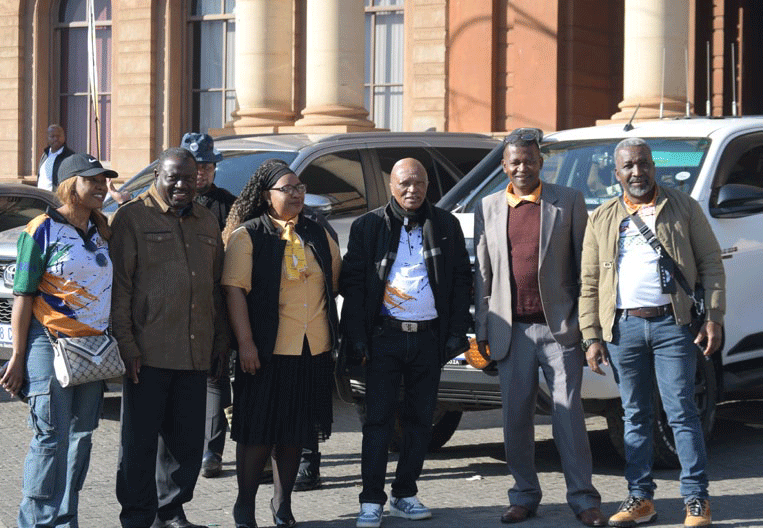
The week of 12 May 2022 marked a pivotal turning point for South Africa’s taxi industry, as delegates gathered at Sun City in the North West Province for the South African National Taxi Council (SANTACO) National Elective Conference. The outcome introduced a new transformation agenda and ushered in the youngest president in the organisation’s history, Motlhabane Abnar Tsebe. His rise was swift, having been elected chairperson of SANTACO Gauteng just three days earlier, signalling both confidence in his leadership and urgency for renewal within the sector. In this TaxiWorld exclusive, Tsebe reflects on his first term of office.
TAXI VIOLENCE
In his maiden address, Tsebe struck a resolute tone, repeatedly calling for an end to gun violence within the taxi industry. He pledged to use his office to advocate for peace and stability. However, as his first term draws to a close, the persistence, and in some instances escalation of violence has cast a shadow over these commitments. Reports of continued attacks and the loss of prominent taxi entrepreneurs and leaders have underscored the ongoing crisis, with limited visible progress from law enforcement in securing arrests.
Despite these challenges, Tsebe has sought to engage the highest levels of government. He formally wrote to President Cyril Ramaphosa, urging the reprioritisation of taxi violence units across South African Police Service facilities to address the crisis more effectively and with urgency. While operational details remain limited due to security concerns, it has been confirmed that the matter has received attention from the Office of the President, an intervention that Tsebe says has provided some measure of reassurance.
COVID-19
Tsebe assumed office in the aftermath of the COVID-19 pandemic, a period that had significantly disrupted the taxi industry. Restrictions on movement sharply reduced demand for services, resulting in financial strain across the sector. His presidency also followed the 2020 National Taxi Lekgotla, where commitments were made between government and the taxi industry to formalise and corporatise operations, adopt technological innovation, improve road safety, and introduce automated fare collection
systems.
CASHLESS FARE SYSTEM
Under his administration, SANTACO has pursued these commitments through a series of collaborative initiatives involving government and the private sector. A notable development has been the rollout of a cashless fare system, Farepay, which launched in September 2025 at the Marabastad taxi rank on the Randburg route. The system has reportedly increased income for vehicle owners by addressing the longstanding issue of “imali ye sokisi,” where drivers would withhold a portion of daily earnings and underreport revenue.
Parallel to this, Tsebe and fellow operators have advanced a corporatisation model for taxi businesses. Through a partnership involving the Pretoria Randburg Soshanguve Taxi Association (PRSTA), the World Bank, and the Development Bank of Southern Africa (DBSA), a cooperative named Thandbantu has been established.
The cooperative operates a professionalised service model, employing drivers and staff in accordance with national labour legislation. The initiative is positioned as a pilot, with expectations that it will be expanded to other provinces.
As Farepay prepares for expansion into KwaZulu-Natal following its Gauteng implementation, Tsebe’s tenure reflects a complex balance of reform efforts and unresolved challenges. While violence continues to test the industry’s stability, his administration’s focus on innovation, formalisation, and institutional collaboration marks a significant chapter in SANTACO’s evolving landscape.
TAXI RECAPITALISATION
Under Motlhabane Abnar Tsebe’s administration, the Taxi Recapitalisation South Africa (TRSA) programme has continued to evolve beyond its original mandate of scrapping ageing taxi vehicles manufactured up to October 2006. The government initiated agency has diversified its scope to include economic empowerment initiatives for taxi associations. Among these is the introduction of “Business in a Box,” a model that enables associations operating within a single ranking facility to jointly own and manage spare parts shops, creating new revenue streams within the industry.
The agency has also taken on a developmental role in preparing the sector for a transition from fuel-powered vehicles to electric minibuses. In this context, Tsebe undertook a visit to China to observe the growth of the electric vehicle sector and assess its potential implications for South Africa’s taxi industry. The visit formed part of broader efforts to position operators not only as adopters of new technology but also as participants in related business opportunities, including the ownership of charging stations and other ventures within the emerging value chain.
UNITY
A central theme of Tsebe’s presidency has been the pursuit of unity across the broader roadbased public transport sector. His administration has made strides in integrating e-hailing services, metered taxis, scholar transport operators, cross-border services, and shuttle providers into the SANTACO fold. These efforts have begun to yield measurable inroads, reflecting a more inclusive approach to representation within the industry.
WOMEN

Tsebe has also positioned his leadership as supportive of women’s empowerment within the organisation. During his tenure, the SANTACO Women’s Desk was renamed SANTACO Women, a move intended to remove perceptions that women’s roles were confined to administrative or office-based functions. This shift was reinforced at the 2025 SANTACO Women Conference, where policy proposals reflecting expanded participation were considered and are now awaiting ratification at the upcoming national conference.
Institutionally, his administration convened a policy conference aimed at reviewing SANTACO’s constitution and broader policy framework to ensure alignment with current industry needs. The outcomes of this process are expected to be finalised at the next national gathering. Tsebe has emphasised that these developments are the result of a collective leadership approach, noting that the National Office Bearers have been actively involved in daily operations through structured strategic workshops and clearly defined portfolio responsibilities.
ROAD SAFETY
Road safety has also remained a focus area. The SANTACO Hlokomela campaign was revitalised under his leadership, with its impact noted during the 2025 festive season. Minister of Transport Barbara Creecy acknowledged the council’s visibility, proactive interventions, and contribution to a reduction in road safety statistics during this period.
PRESIDENCY HIGHLIGHTS
Reflecting on these developments, Tsebe described them as key highlights of his first term, reiterating that progress has been driven through collaboration between himself and the organisation’s leadership collective. He maintains that SANTACO continues to play a significant role within the broader transport sector, even as the industry navigates ongoing challenges and transformation.